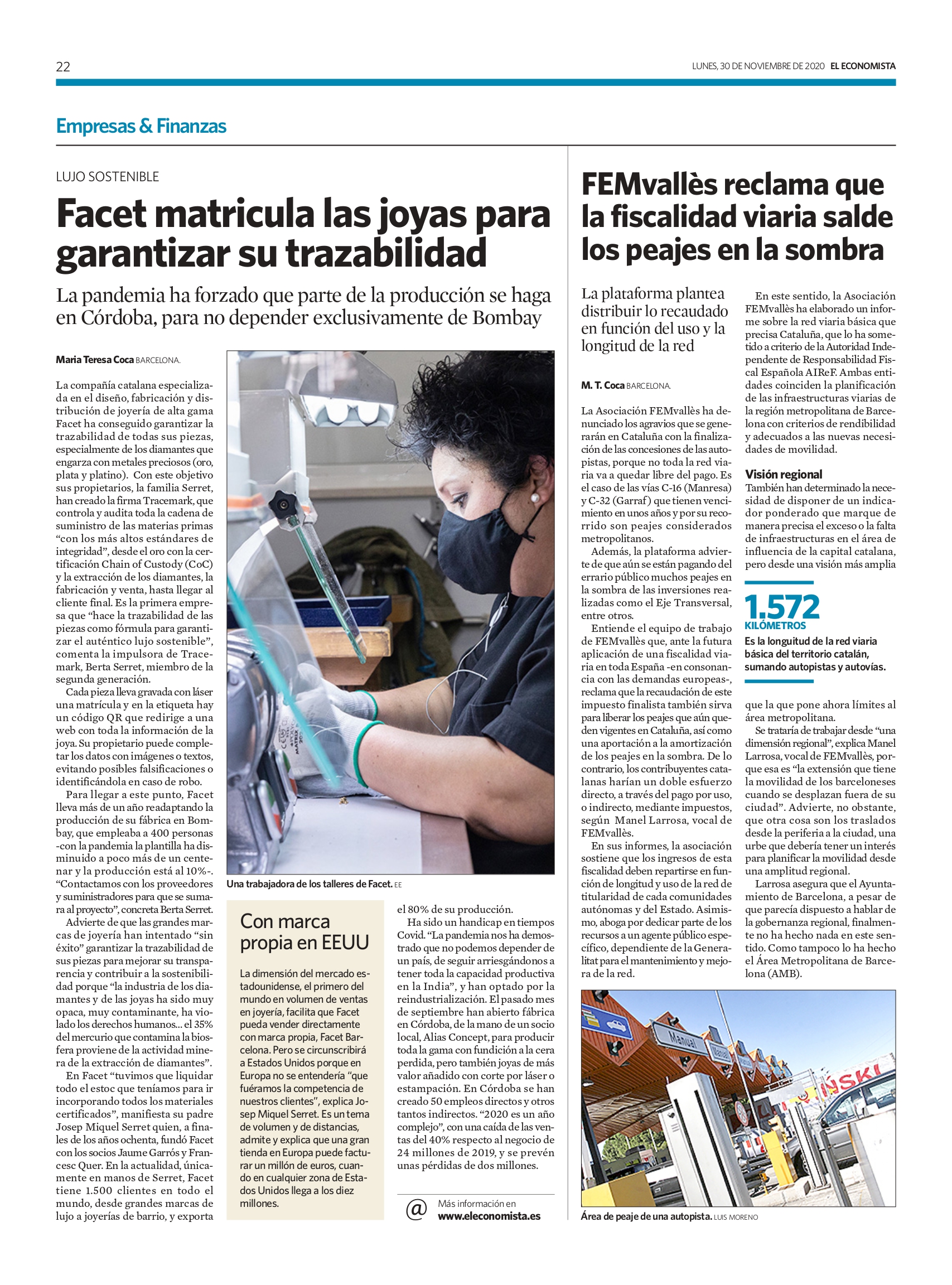
“Facet encodes its jewelry to guarantee its traceability” – El Economista
The Catalan company specialised in the design, manufacture and distribution of high-end jewelry, Facet, has been able to guarantee the traceability of all of its pieces, specifically diamonds and precious metals (gold and silver).
To this end the owners, the Serret family, have created Tracemark, a firm which controls and audits the jewelry supply chain “with the highest standards of integrity,” from CoC (Chain of Custody) certified gold, diamond extraction, the manufacture and the sale of the jewelry, all the way to the end consumer who can access this information. It is the first company that “uses traceability as a key to guaranteeing authentic sustainability in luxury” comments Berta Serret, member of the second generation of the Serret family.
Each piece is laser-engraved with a serial number, and sold with a tag featuring a QR code that redirects to a unique website where all the information about the jewel can be found. The owner of the piece can add to the data with images or text, avoiding falsification and even identifying the piece in the case of robbery.
In order to get here, Facet has spent more than a year reimagining and readapting the production of its Mumbai factory which employed 400 people. With the pandemic, only around one hundred people now work at the India plant, and production is at 10% of its original capacity. “We reached out to suppliers and providers to get them on board with the project”, affirmed Berta Serret.
She informs that some large jewelry brands have “tried, and failed” to guarantee the traceability of their pieces to improve transparency and contribute to sustainability because “the jewelry and diamond industry has always been very opaque, a polluter, and has a history of violating human rights. In fact, 35% of the toxic mercury found in the biosphere comes from mining activity and the extraction of diamonds.”
Tracemark, a pioneering traceability solution
Tracemark is born with the aim to be a tool for all jewelry manufacturers who want to guarantee the sustainability of their pieces. The firm will offer its services to third parties who “are able to adhere to our protocol and guarantee the traceability of every part of their production process,” explains Berta Serret.
At Facet, “we had to liquidate all our stock in order to begin incorporating all of the certified materials,” says her father Josep Miquel Serret who at the end of the 1980s founded Facet with partners Jaume Garrón and Francesc Quer. Josep Miquel Serret highlights that “you have to be willing to meet the ethical and sustainability criteria and really believe in what you’re doing, because in some processes you lose competitivity.”
Currently purely in Serret’s hands, Facet designs and manufactures for companies and distributors across the world: some 1,500 customers from large luxury brands to neighbourhood jewellers, exporting 80% of its production.
Its dependency on foreign markets and its set-up in India has been rather a handicap in times of COVID. “The pandemic has taught us that we can’t depend on just one country, and we certainly can’t keep risking it by having all of our capacity located in India.” As a consequence, they have opted for reindustrialisation.
This September Facet opened a factory in Córdoba through local partner Alias Concept in order to produce their whole range using lost-wax casting and higher value items using laser cutting and stamping. In Córdoba they have directly created 50 jobs, and indirectly many more. “2020 is a complicated year”, with Facet expected to take in around €14.4 million with a fall in sales of around 40% compared with €24 million in 2019. They expect to see a loss of around €2 million in 2020.
Facet, now with its own brand
The size of the US market, the biggest in the world in terms of jewelry sales volume, has made it possible for Facet to sell under its own brand name: Facet Barcelona. This, however, is limited to the US market itself because in Europe it would mean “being in competition with its own customers” explains Josep Miquel Serret.
“It’s all about volume and distance”, he admits. “A large shop in Europe could taken in €1 million, while anywhere in the United States the figure would be around 10 million.”
Taken from the original article in El Economista:
https://tracemark.tech/wp-content/uploads/2020/11/ElEconomista-30.11.2020_page-0001.jpg